Custom swerve
Four MK4i modules, field-oriented control, custom kinematics and PID feedback, with a Pigeon 2.0 and CANCoders for heading and module alignment.
Project 01
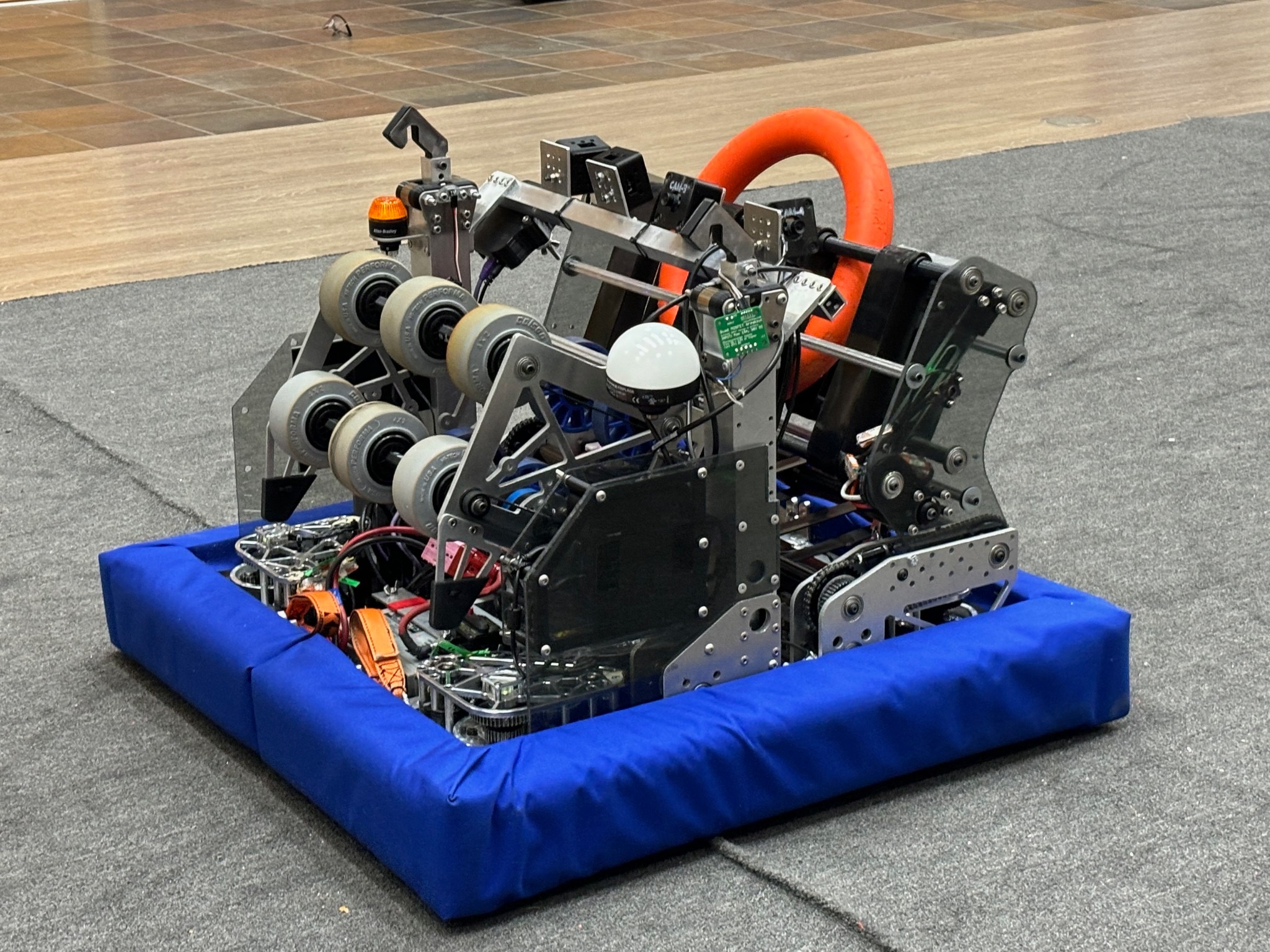
A compact, fast FRC robot built to score from anywhere on the field, combining custom swerve control, AprilTag localization, and optimized autonomous trajectories.
The challenge
For the 2024 Crescendo season, we chose to build a strong first-pick robot: small enough to pass under the stage, light enough to take advantage of our L3 swerve modules, and consistent enough to score speaker notes throughout a match.
The robot needed to reduce driver workload, not add to it. That made localization, automatic mechanism sequencing, and predictable closed-loop control central to the design.
System architecture
Four MK4i modules, field-oriented control, custom kinematics and PID feedback, with a Pigeon 2.0 and CANCoders for heading and module alignment.
Four global-shutter cameras provide near-360° AprilTag visibility. Pose estimates are fused with odometry to stabilize field position.
The shooter, intake, pivot, and handoff work as coordinated subsystems, using velocity and position feedback before a note can fire.
Autonomous path testing
Repeatability under field conditions
Autonomous motion
We first built our own cubic Bézier trajectory implementation, using sampled lookup tables and PID control to follow a normalized translation vector. The result worked, but creating and tuning paths remained time-intensive.
We then integrated Choreo, translating its JSON output into our custom swerve code. Accounting for the robot’s mass, motors, and gearing produced faster path creation and more reliable autonomous routines.
Result
Front-Runner paired fast cycling with driver assists and observable telemetry. The work built on four years of swerve development and helped Team 3082 enter competition with a maintainable, testable controls platform.